
loading...
New Energy Materials

High Pressure & Micro-Jet Homogenizer for New Energy Materials

In the fields of new energy and advanced materials, the preparation and processing of materials such as graphene, carbon nanotubes (CNTs), metal oxides, Pt/C catalysts, PEDOT conductive polymers, MLCC/CMP slurries, and nanocellulose place extremely high demands on process technology, nanostructure control, dispersion stability, and production efficiency directly influence the performance and reliability of the final products.

ATS homogenizers deliver high-performance solutions, providing efficient dispersion and stabilization for critical applications. Covering the entire chain from laboratory research and development to large-scale production, helping global companies develop more competitive and innovative new-energy materials.
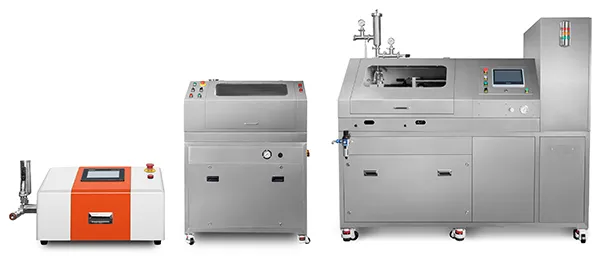
Advantages of ATS Homogenizers in New Materials Preparation and Processings
  • Highly Efficient Nano Dispersion & Processing
    ATS high-pressure homogenization can manage high-viscosity and high-solids nanomaterial suspensions, such as graphene and carbon nanotubes (CNTs) dispersions. The homogenizers operate at high pressure up to 2000 bar or more, and utilize intense shear forces, effectively preventing nanomaterial agglomeration. This results in a uniform and stable nanoscale dispersion, enhancing material performance consistency.
  • Material Integrity & Stability Preservation
    ATS high-pressure homogenizer features a heat exchange system for precise temperature control, as maintaining a stable temperature is crucial during high-pressure processing. The heat exchange system prevents target proteins from denaturing or degrading due to overheating during the disruption process, maximizing sample performance and yield.
  • Excellent Repeatability and Scalability
    Homogenization results, such as disruption rate, energy consumption, and temperature rise, are consistent across different batches. Leveraging expertise in fluid dynamics models allows laboratory-scale process parameters to be successfully and linearly scaled up to industrial-scale. This ensures scalability and greatly minimizes process-transfer risks, and reduces time for product launching.
  • Durability and Low Maintenance
    ATS homogenizers can be customized with highly durable materials, such as zirconia ceramics and synthetic diamonds, for high-hardness and abrasive slurries (e.g., ceramic powder). This significantly increases service life, minimizes maintenance costs, and reduces downtime for long-term operation.
Recommended Products for Dispersion Application
High Pressure Homogenizers
  • Equipped with a variable flow control system to flexibly adjust flow rates
  • Built with corrosion-resistant materials, extending service life
  • Compliant with CE certification
  • Customizable configurations for PLC/explosion-proof/sterile requirements
  • Four-layer overpressure protection ensures operational safety
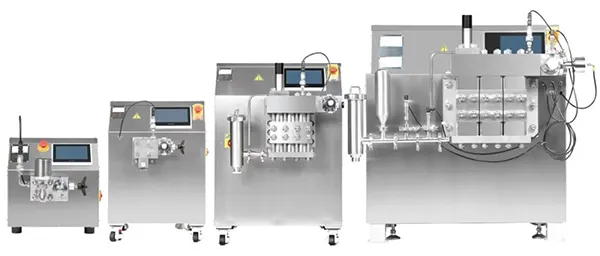
  • High scalability from laboratory to industrial scale (max flow rate of 4000 L/H)
Micro-Jet Homogenizers
  • Superior dispersion effect and narrower particle size distribution
  • Higher processing efficiency and result consistency
  • Excellent process repeatability and scalability
Advantages of ATS High Pressure Homogenizer Processing Various Materials
  • New Energy Materials
    Graphene/Carbon Nanotubes (CNTs): Achieve efficient, non-destructive dispersion processing, while maintaining material conductivity and mechanical properties.
    Metal Oxide Electrode Materials: Produce uniform nano-sized particle distribution, which improves battery energy density and cycle life.
    Pt/C Catalysts: Produce uniform dispersion of catalyst particles, improving the catalyst’s activity and stability.
  • Electronic Chemical Materials
    PEDOT Conductive Polymer: Uniform dispersion at the molecular level, improving conductivity and light transmittance.
    MLCC/CMP Slurries: Prepare nanoparticle polishing with highly uniform nanoscale particles, enhancing product yield and performance.
  • Bio-based Materials
    Nanocellulose: Efficient depolymerization and nanonization processing, while maintaining fiber strength and high specific surface area characteristics
Cases
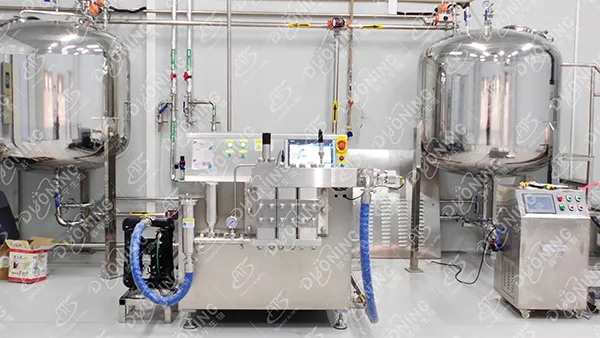
  • Carbon Nanotube (CNT) production line Carbon Nanotube (CNT) Production Line
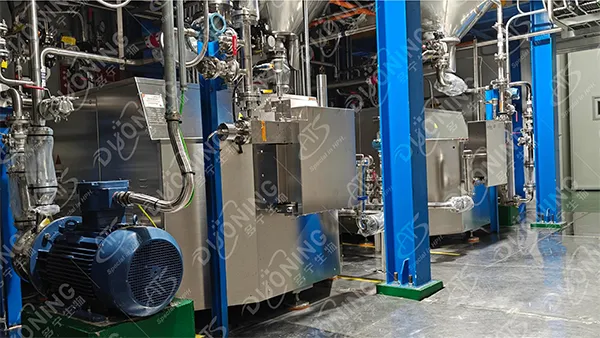
  • Double-Walled Carbon Nanotube (DWCNT) production line Double-Walled Carbon Nanotube (DWCNT) Production Line
Experimental Cases
Platinum Carbon (Pt/C) Catalyst Slurry Dispersion

The surface energy of 3–5 nm platinum nanoparticles is extremely high, causing strong tendencies toward agglomeration, and the properties of the catalyst slurry significantly influence the structure formation of the catalyst layer. Therefore, the dispersion method used in preparing the catalyst slurry is critical for producing high-performance membrane electrode assemblies (MEAs).

Equipment
Laboratory high-pressure homogenizer

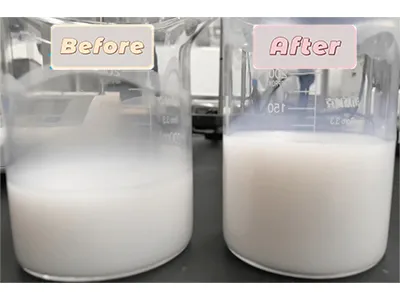
A comparison of the platinum carbon catalyst slurry before and after dispersion shows that the degree of precipitate has significantly decreased after dispersion.

The particle size of the dispersed slurry was measured by a laser particle size analyzer. The particle size distribution was between 202.3nm–444.4nm, with an average of particle size of 290.5nm.
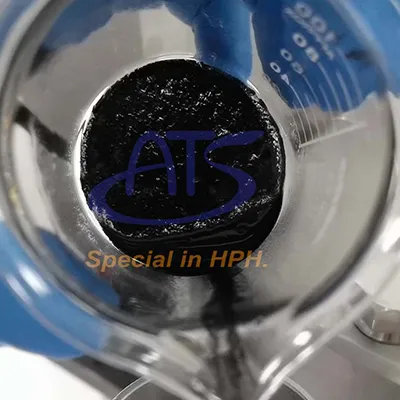
  • Before dispersion Before dispersion
  • After dispersion After dispersion

PVDF (Polyvinylidene Fluoride) Solution Dispersion Using High-Pressure Homogenizer
  • Application of ATS high-pressure homogenization in the PVDF industry
    During use, PVDF powder must be uniformly dispersed in a suitable solvent to prevent precipitation and ensure consistency, both of which are crucial to product stability and performance. ATS high-pressure homogenizer effectively resolves issues of uneven PVDF distribution, reduces particle size, and improves material stability and utilization rate.
  • Appearance changes of PVDF liquid after dispersion
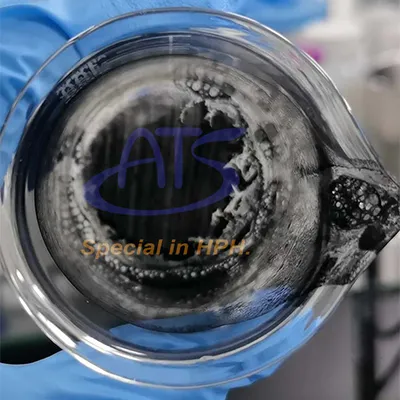
    After dispersion, the PVDF liquid remains white. However, after shaking the liquid, a blue luster appears on the cup wall.
  • Particle size measurement
    Comparing the particle size charts of the PVDF dispersion before and after the experiment shows the D50 particle size decreased from 6.043 μm to 0.216 μm, indicating a significant reduction to the nano-scale.
PVDF dispersion before processing

Sodium Battery Metal Oxide Pulverization Using High-Pressure Homogenizer
  • Equipment
    ATS Pilot-scale Homogenizer
  • Experimental process
    An ATS high-pressure homogenizer with a temperature-controlled system is used to break down materials under different pressures and observe the pulverization results. The expected particle size is around 300nm

Experimental results
Visual observation
The metal oxide's appearance showed no significant visible change before and after pulverization. After being left aside for a certain duration, the higher pressure resulted in slower stratification of the sample.
Particle size measurement
The particle size of the metal oxide was significantly reduced after being pulverized by the high-pressure homogenizer. The average particle size reduced from 12.05μm to 303nm, meeting the experimental expectations.
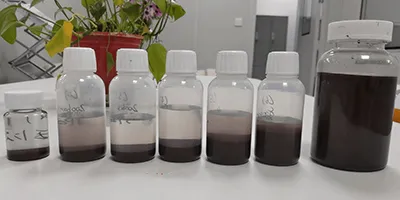
Metal oxide sample before pulverization
Ready to Start Your Project?

Let us help you find the right nano-processing equipment to support your R&D, scale-up, and production needs.


Applications